Protection & Enhancement
Aircraft Brightwork Restoration
Brightwork — the unpainted, polished aluminium an aircraft wears on leading edges, engine inlet lips, spinners and trim — oxidises steadily from the moment it is last polished. Dull, hazed metal drags down the presentation of an otherwise excellent aircraft; a genuine mirror finish transforms it.
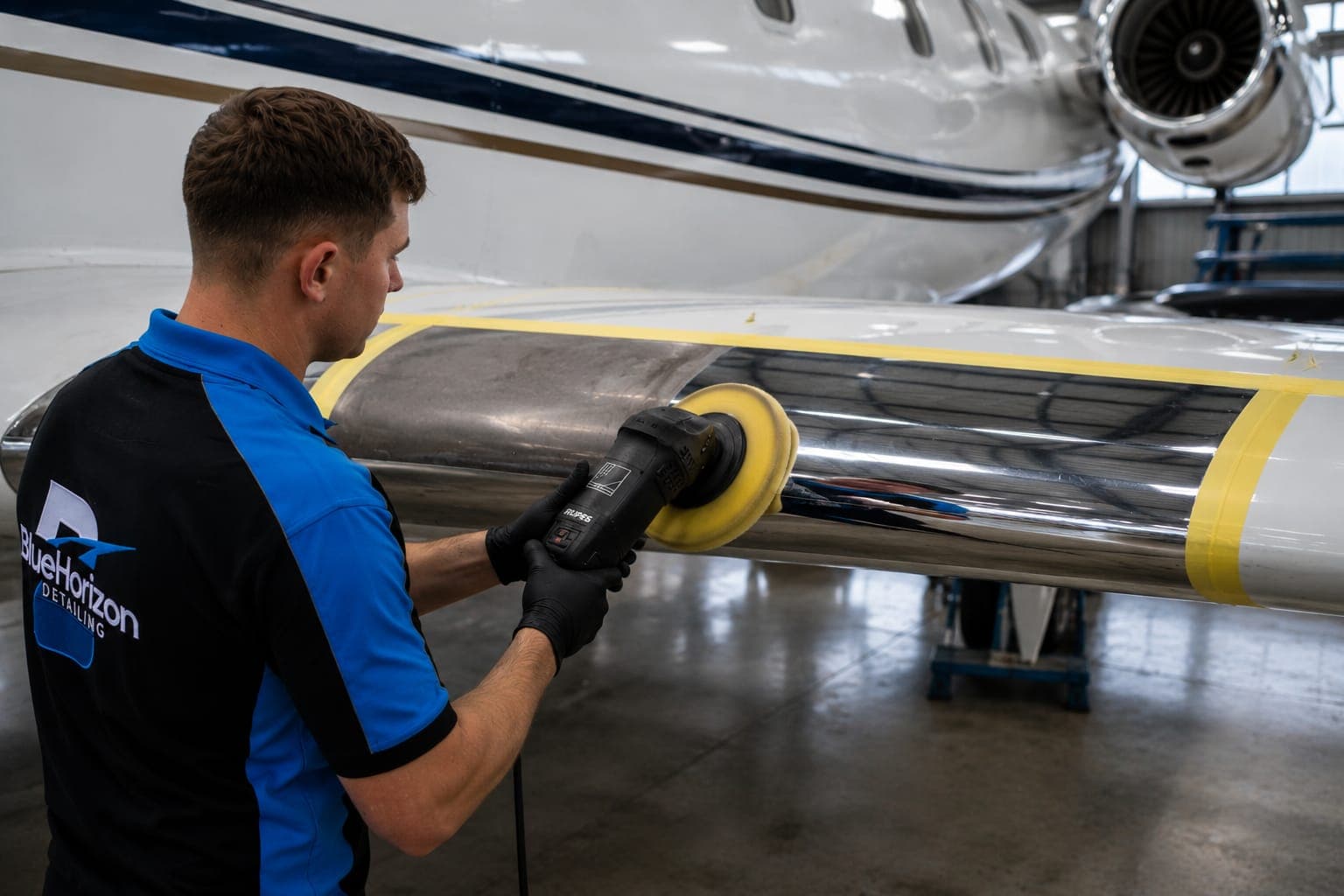
Restoring brightwork properly is graded, patient machine work: heavier cutting compounds where oxidation demands it, stepped down through progressively finer grades to a swirl-free mirror. It is one of the most skilled jobs in aircraft appearance care, and one of the most satisfying to see finished.
Suitable for
- Private Owners
- Business Jets
- Aircraft Management Companies
The process
Assessment establishes what the metal needs: light oxidation may polish out with fine grades, while neglected or weathered brightwork needs a staged approach beginning with cutting compounds. Work proceeds with appropriate machines and clean media, panel by panel, with surrounding paint masked and protected throughout.
We use graded aviation metal-polishing systems — the compound families developed specifically for aircraft aluminium, conforming to metal-polish specifications such as AMS 1650 — finishing with grades fine enough to leave true clarity rather than a bright haze. As an optional extra, a protective coating (we use Xzilon X20, an aerospace coating) can then slow re-oxidation and keep the restored finish beading between visits.
Where brightwork appears
Classic King Airs and older Cessnas and Beechcraft carry polished leading edges; many types wear polished spinners and inlet lips; and fully polished vintage airframes are their own discipline, which we scope and quote individually. Because leading edges live next to de-icing boots, sensors and erosion strips, the no-touch zones matter as much as the polished ones — masking and protection are part of the craft.
Why it matters
What this service gives you
True mirror finish
Graded polishing to genuine clarity — not a one-pass shine that hazes back in weeks.
Specification products
Aviation metal-polish systems appropriate to aircraft aluminium.
Protected surroundings
Paint, boots and sensors masked and respected throughout.
Slower re-oxidation
Optional protective treatment keeps the finish brighter for longer.
Questions
Brightwork Restoration — questions answered
How often does brightwork need polishing?
Flown aircraft typically need attention two to four times a year to hold a mirror standard, depending on exposure and whether a protective treatment is applied. We can schedule this within a maintenance programme so the finish never slides backwards.
Can badly oxidised metal be recovered?
Usually, yes — heavier oxidation simply needs more aggressive starting grades and more time. Genuine corrosion pitting is a different matter: polishing improves its appearance but metal condition is an engineering question, and we'll flag anything that needs an engineer's eye.
Do you polish around de-icing boots safely?
Yes — boots, erosion strips and sensors are masked and excluded. Polishing compounds and machines never touch rubber de-icing surfaces, which have their own dedicated care regime.
Related
Services that pair with this one
- Paint Enhancement & ProtectionGloss brought back by machine, then locked in — polymer sealant or long-term coating chosen to suit your aircraft, not sold separately.Explore →
- Exterior Aircraft DetailThe complete exterior service: inspected, washed by the safest appropriate method, finished nose to tail — you never have to choose how.Explore →
- Paint Enhancement & ProtectionGloss brought back by machine, then locked in — polymer sealant or long-term coating chosen to suit your aircraft, not sold separately.Explore →
Ready to book brightwork restoration?
Tell us the type, where it's based and what you need. We'll come back promptly with a clear, honest quotation.